



Hemispheric Workshop “Just Transition, green and blue jobs in the Americas: Contributions from the world of work to environmentally sustainable economies and societies"
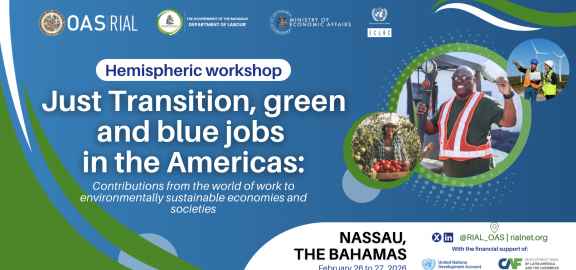
The Workshop “Just Transition, green and blue jobs in the Americas: Contributions from the world of work to environmentally sustainable economies and societies” will convene representatives of Ministries of Labor, Ministries of Sustainable Development, workers’ and employers’ organizations -grouped in COSATE and CEATAL-, as well as international organizations, to share experiences and develop policy recommendations on these priority issues, in line with the objectives outlined below.
General Objective
- To enhance the knowledge and strengthen the capacities of the region’s Ministries of Labor and social actors to promote just transition processes that generate green and blue jobs, promote labor inclusion, protect labor rights, and contribute to environmentally sustainable economies and societies.
Specific Objectives
- To identify, exchange, and analyze initiatives and proposed solutions from Ministries of Labor to address and mitigate the negative impacts of climate change on the world of work -including strategies for occupational safety and health, social protection, and labor inclusion- as well as to promote the creation of green and blue jobs through training, reskilling, and upskilling efforts.
- To strengthen the linkages between the Ministries of Labor and the Ministries of Sustainable Development and the Environment, in order to facilitate interinstitutional coordination of public policies that comprehensively and coherently address the challenges of the climate and environmental crisis, as a result of climate change, in the world of work.
- To develop policy recommendations that guide Ministries of Labor in designing and implementing public policies to promote just transition processes that generate green and blue jobs, promote labor inclusion, protect labor rights, and contribute to environmentally sustainable economies and societies.
This is an activity of the Inter-American Network for Labor Administration (RIAL), co-organized by the OAS, the Ministries of Labour and Public Service and of Economic Affairs of The Bahamas, and the Economic Commission for Latin America and the Caribbean (ECLAC). It is part of the Work Plan 2025-2027 of the IACML, and the United Nations Development Account project "Labor Inclusion to Address Climate Change and Its Impacts on the Future of Work in Latin America and the Caribbean," implemented by ECLAC.
LINK TO EVALUATION SURVEY:
https://tinyurl.com/RIALNassau
| Attachment | Size |
|---|---|
 Base Document - Updated Agenda (February 25) Base Document - Updated Agenda (February 25) | 1.38 MB |
 Information Bulletin Information Bulletin | 500.22 KB |
| Preliminary list of participants (February 20) | 546.53 KB |
1st Session – Aligning labor and environmental agendas for a sustainable future (*Inter-Sectoral session)
Guiding question for presentations and dialogue:
1. How is your country integrating labor and environmental agendas to promote a just transition and address the impacts of climate change on the world of work?
Please consider institutional coordination mechanisms; joint policies; concrete strategies or actions developed jointly between the Ministry of Labor and Ministry (or authority) of Environment/Sustainable Development; and participation of the Ministry of Labor in regional or global climate or sustainable development agendas, among others.

2nd Session – Social Protection and Labor Inclusion in Green Transitions
Guiding question for presentations and dialogue:
2. What strategies is your country —particularly through the Ministry of Labour— implementing to address the negative impacts of climate change on the world of work and ensure a green transition that is inclusive and equitable? What have been the main achievements, challenges, and lessons learned from these efforts?
Please consider occupational health and safety, social protection and labor inclusion strategies, among others.
3rd Session – Training, reskilling and upskilling for green and blue jobs
Guiding question for presentations and dialogue:
3. What strategies is your country—particularly through the Ministry of Labour—implementing to equip the workforce, including youth, with the skills required to participate in and benefit from green and blue economy jobs? What have been the main achievements, challenges, and lessons learned from these efforts?
Please consider skills anticipation, training, reskilling and upskilling strategies, among others.